

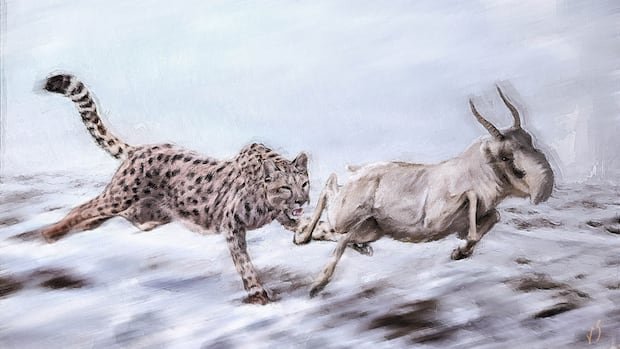

In the initial discovery, skeletal remains unearthed in the Bluefish Caves and a mining site in northern Yukon were initially presumed to be from an ice-age puma or cougar. However, DNA analysis conducted by the University of California revealed a different story. Molly Cassatt-Johnstone, a former lab technician fresh out of her undergraduate studies, was behind the groundbreaking examination of the Yukon bones, marking one of her early sample analyses.
When Cassatt-Johnstone first reviewed the preliminary results, the findings deviated significantly from typical puma characteristics, leading to the surprising revelation that the specimens were not cougars but rather cheetahs. Yukon paleontologist Grant Zazula vividly recalls the moment he received the unexpected message stating, “Hey Grant, your cougars aren’t cougars — they’re actually cheetahs.”
Zazula reflects on the evolution of genetic analysis on ancient DNA, highlighting the significant advancements that have transformed it from a realm of science fiction to a routine practice with permafrost-preserved specimens from the Yukon. Cassatt-Johnstone’s identification of a Yukon Miracinonyx, the extinct American cheetah, positioned her as the lead author of a paper recently published in Current Biology, unveiling fresh insights into the ice-age feline’s dietary habits and habitat range.
The study challenged conventional beliefs that the American cheetah, resembling modern-day cheetahs with their elongated limbs and slim physique, would have primarily pursued pronghorns across grassy terrains. The unexpected discovery of these creatures in the Arctic tundra puzzled paleontologists, as they had previously been considered specialized predators of American pronghorn antelope in regions like the lower 48 states where pronghorn were abundant, unlike the Beringia region where they were found.
To unravel the mystery of how Miracinonyx thrived in such a habitat, researchers, collaborating from Canada and the U.S., employed stable isotope analysis. This technique, commonly used in forensic investigations, delves into chemical signatures to discern ancient diets and environmental conditions, shedding light on potential migration patterns. Through an intricate analysis of bone fragments from the cheetah’s limbs, researchers like Matthew Wooller probed deep into the creature’s dietary preferences, uncovering an unexpected reliance on fish, a behavior atypical for historical and contemporary felines.
The study’s outcomes challenged existing perceptions, indicating that Yukon cheetahs heavily favored salmon as a staple food source, a unique strategy in a region teeming with formidable predators like Beringian lions, scimitar cats, and giant short-faced bears. The preference for fish likely stemmed from the abundant availability of salmon, offering a convenient and plentiful food source amidst fierce competition for prey. The research also unveiled genetic similarities between Miracinonyx and North American pumas, shedding light on their limited genetic diversity, potentially contributing to their eventual extinction.
The existence of these Arctic felines engaged in fishing activities prompted Zazula to advocate for reclassifying the distinct northern population from ‘American Cheetah’ to ‘Yukon Cheetah.’ This unexpected revelation underscores the ongoing discovery potential within the Yukon’s paleontological landscape, emphasizing how each new bone fragment has the power to unveil a previously unknown chapter in the region’s ancient fauna.