

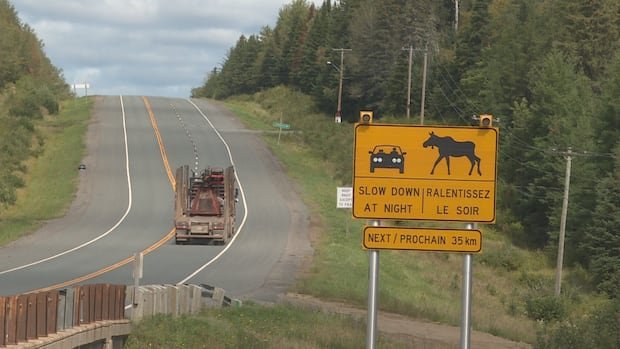

On a dim Saturday evening in late August, the Chaleur Lightning hockey team had just completed an exhibition match against the Miramichi Timberwolves and boarded the team bus for their return journey to Bathurst.
Assistant coach Alex Ouellet recalled a moment when the driver suddenly gasped during the early stages of the drive. “It happened within minutes,” said Ouellet. “I saw a figure ahead of us, followed by a loud bang.”
The team bus collided with a moose on the highway, but fortunately, Ouellet mentioned that everyone, except the driver who sustained minor scratches, emerged unharmed from the incident.
Reflecting on the encounter, Ouellet expressed that the team would remember it vividly, much like other New Brunswickers who have faced similar scenarios involving large animals.
Coincidentally, the province had announced the addition of two new wildlife crossings on the same highway stretch that very week.
These wildlife tunnels and fencing methods are employed by the province to deter moose from straying onto roadways. Transportation Minister Chuck Chiasson explained that the decision on installing these measures is guided by collision data provided by law enforcement to identify high-risk areas.
While extensive wildlife fencing lines both sides of 331 kilometers of New Brunswick highways, Chiasson emphasized the need for wildlife crossings to allow animals to move through their habitats without disruption.
There are currently 82 wildlife crossings in various parts of New Brunswick, including two recently constructed tunnels on Route 8 between Miramichi and Bathurst. These tunnels, over four meters tall and wide, are designed to accommodate large animals, ensuring safe passage under the highway.
Graham Forbes, a wildlife ecologist from the University of New Brunswick, highlighted the importance of making the tunnels intuitive for animals to use effectively. He mentioned that various wildlife species, not just large mammals, have been observed using these underpasses.
Despite the presence of wildlife tunnels, the Department of Transportation has not observed a significant decrease in collisions, with 409 incidents reported in 2024, including injuries and one fatality. Chiasson emphasized the department’s commitment to enhancing safety measures, including vegetation clearance to improve visibility on highways.
Looking ahead, Ouellet expressed hope for additional fencing in the area to enhance safety, acknowledging the challenges of completely preventing collisions with wildlife. He underscored the importance of implementing preventive measures to mitigate such risks effectively.