

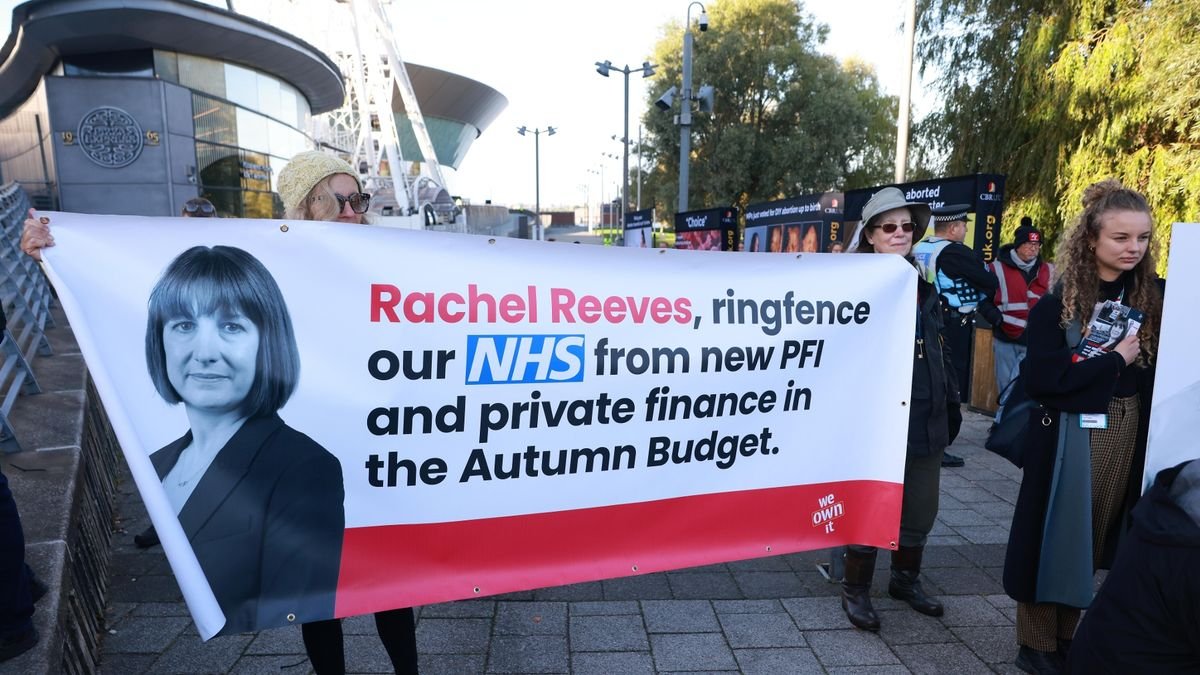

A group of Members of Parliament (MPs) has urged Chancellor Rachel Reeves to abandon the proposal to reintroduce private debt agreements for the NHS. Activists confronted MPs outside the Labour Party Conference, insisting on upholding the pledge made in the 2024 election manifesto to maintain the NHS as publicly owned and funded. Private finance deals, aimed at keeping government debt off the balance sheet, could lead to exorbitant interest rates for NHS trusts over an extended period.
The protest occurred just before Rachel Reeves delivered her keynote speech at the conference in Liverpool. The final decision on whether to utilize a form of private finance scheme to finance numerous new medical centers across England will be made by the Chancellor in her Autumn Budget on November 26.
Cat Hobbs, the founder of We Own It, which coordinated the protest, expressed disappointment, stating that proceeding with the plan would constitute a breach of trust with voters who elected Labour to safeguard the NHS. The use of public-private partnerships (PPPs) and private finance initiatives (PFI) was expanded during Tony Blair’s Labour government tenure, allowing for the construction of hospitals without adding to the national debt.
Unlike government borrowing at lower rates, NHS trusts under PFI agreements directly borrow from private consortiums at significantly higher interest rates, resulting in substantial repayments over time. The potential financial burden on NHS trusts from servicing PFI debts can consume a significant portion of their funding.
The proposal to employ a version of PPP to meet fiscal targets set by Rachel Reeves includes a commitment to reducing public debt as a portion of the economy within five years. The activists presented a large board to MPs, questioning their commitment to the NHS remaining publicly owned and funded as pledged in the Labour manifesto.
Various MPs, including Bell Ribeiro-Addy and Ian Byrne, emphasized the importance of protecting the NHS from further involvement with PFI schemes. Darren Jones, the chief secretary to the Treasury, defended the use of PPPs in England as a means to expedite the establishment of neighborhood health centers as part of the Government’s Ten Year Health Plan. These centers aim to provide diverse healthcare services closer to local communities, thereby relieving the pressure on hospitals to focus on critical care.
Scotland and Wales have introduced their own alternative models to PPPs, emphasizing the need for value for money in such arrangements. The debate continues on the appropriate financing mechanisms for crucial healthcare infrastructure projects, with concerns raised over the long-term financial implications of private finance deals on the sustainability of the NHS.