

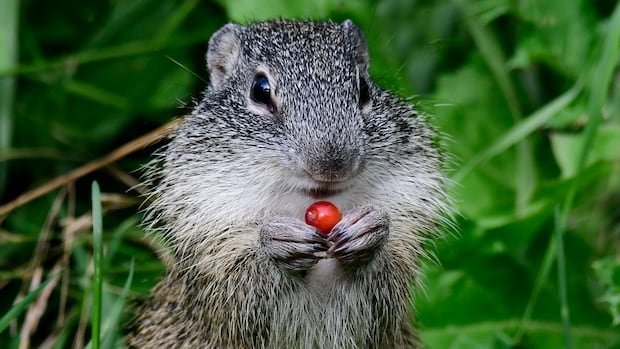

Scientists are seeking the help of residents in Alberta to keep an eye out for a rare rodent species. The Franklin’s ground squirrel, a creature that has been difficult to spot, is the focus of a research initiative spearheaded by wildlife biologist Jess Haines in collaboration with Nature Alberta, a conservation organization.
Haines explained that the project was initiated due to concerns raised by local naturalists about the declining population of the squirrel, which was not being actively studied. The research aims to demonstrate the decline in the population of Franklin’s ground squirrels. Currently, the species is classified as “undetermined” by the Alberta government, indicating insufficient data to assess its status.
The project’s objective is to gather substantial data on the population trends of Franklin’s ground squirrels to support changing its status to “at-risk.” Unlike Richardson’s ground squirrels, which thrive in human-altered environments like pastures and golf courses, Franklin’s ground squirrels rely on natural habitats with dense brush and forested areas.
Haines highlighted that the conversion of lands for agricultural and urban development has directly contributed to the decline of the once widespread squirrel population. Previously found throughout central Alberta, southern boreal regions, and possibly the foothills, the species is now limited to a few remaining populations.
Areas where Franklin’s ground squirrels are still observed include Wabamun Lake Provincial Park, Pigeon Lake, Dry Island Buffalo Jump Provincial Park, Rochon Sands Provincial Park, and Buffalo Lake. Haines emphasized that while some populations are thriving, there are concerns about the potential loss of others in the near future.
Unlike other ground squirrel species that live in large, visible colonies, Franklin’s ground squirrels naturally exist in small numbers and low densities, making them vulnerable to disappearing from an area due to their scarcity.
The research project led by Haines and her team, including students, involves extensive fieldwork to locate and study Franklin’s ground squirrels, which are temporarily captured for research purposes and then released back into the wild. The public is encouraged to contribute historical and current squirrel observations through iNaturalist, a platform for sharing wildlife photos and recordings globally.
Historically, 188 sightings of Franklin’s ground squirrels have been recorded on iNaturalist since 2022. Furthermore, individuals can submit historical sightings through a form on the Nature Alberta website, aiding researchers in tracking the species’ past and present distribution in the province.
The project, which has no specified end date but undergoes periodic shifts in focus, is currently concentrating on understanding the squirrel’s diet and habitat. The ultimate goal is to gather comprehensive information to support conservation efforts for the species.
Myrna Pearman from the Red Deer River Naturalists expressed her fondness for Franklin’s ground squirrels, highlighting their friendly nature and amusing behavior. Pearman’s involvement in photographing the squirrels alongside Haines stems from a desire to raise awareness and seek protection for the species from the provincial government.
Attention towards Franklin’s ground squirrels has increased as their declining numbers have become apparent. In Alberta, there are a total of 14 squirrel species, with five being ground squirrels. The distinct features of Franklin’s ground squirrel, such as its grey head and long bushy tail, set it apart from other squirrel species in the region.
As of now, no squirrel species are classified as at-risk in Alberta, but ongoing research and public involvement are crucial for the conservation of the Franklin’s ground squirrel.