

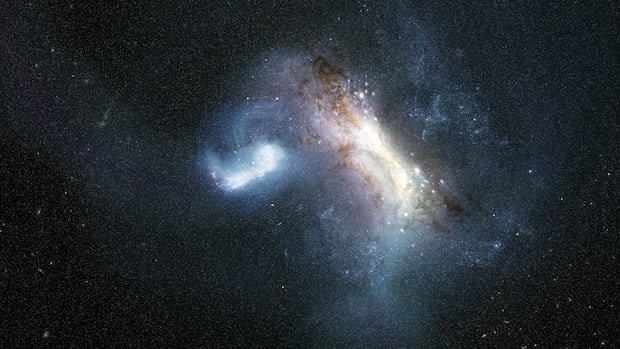

A recent study has shed light on the complex history of the Milky Way galaxy, revealing a significant merger event that occurred approximately 11.8 billion years ago. This event marked the earliest-known galactic merger for the Milky Way, demonstrating how the galaxy grew not only through its own star formation but also by absorbing smaller galaxies.
The study, published in the journal Nature Astronomy, unveiled evidence of a dwarf galaxy merging with the Milky Way, adding a substantial number of stars and interstellar gas to our galaxy’s early development. This merger, named Low-energy-Kraken-Heracles (LKH), occurred about two billion years after the Big Bang, enriching the Milky Way with vital resources for star formation and dark matter.
Utilizing data from the Hubble and Gaia telescopes, researchers analyzed stellar clusters within the Milky Way’s innermost regions, investigating their age, chemical composition, and trajectory. The study suggests that the merger process was relatively peaceful for stars but more turbulent for gas, potentially triggering a surge in star formation.
Astrophysicist Davide Massari, the lead author of the study, emphasized the importance of understanding the Milky Way’s past mergers, including subsequent interactions with galaxies like Gaia-Sausage-Enceladus and Sagittarius dwarf galaxy. These mergers have played a crucial role in shaping our galaxy and, ultimately, our solar system and planet Earth.
By delving into the Milky Way’s history, researchers aim to answer fundamental questions about our origins and the intricate processes that have sculpted our cosmic neighborhood.