

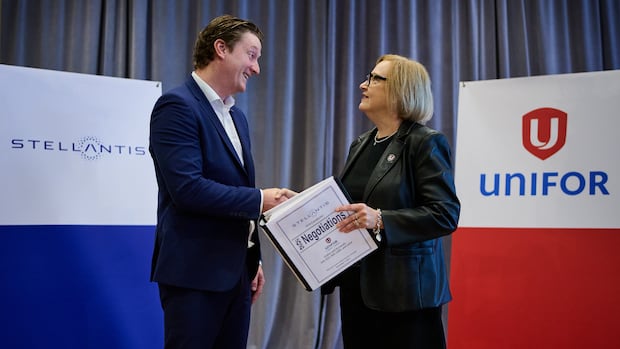

The union representing Stellantis employees cautioned the U.S. automaker against taking its Canadian workforce lightly as Unifor commenced contract negotiations with the company on Tuesday.
These discussions represent the concluding phase of Unifor’s negotiations with the Detroit Three automakers. The union generally employs a pattern bargaining strategy in its automotive sector talks, aiming to establish terms that can be duplicated with other firms.
Although Unifor has successfully ratified new collective agreements with Ford Motor Co. and General Motors in Canada this past summer, the union’s most significant hurdle is yet to come, according to national president Lana Payne.
“I believe we have overcome several challenges, considering the current situation, the uncertainty, the tariffs, and Trump’s trade conflicts, alongside all the substantial obstacles in our path,” she stated during a press conference.
“However, I won’t sugar-coat the reality. We anticipate this round of negotiations to be our toughest and most challenging to date, perhaps even ever.”
The discussions are aimed at finalizing a new agreement by the September 11 deadline. The union has expressed particular concern regarding job security, following the layoff of over 2,000 employees at Stellantis’ Brampton assembly facility, which has been inactive since 2023.
Recently, the union disclosed that it was notified Stellantis was contemplating the closure and sale of the assembly plant. This facility had been intended for retooling for Jeep production, with the process expected to begin in early 2024, but the company suspended these plans in early 2025.
Subsequently, the company declared it would shift production of the Jeep Compass to the United States, a move the union deemed a breach of their current collective agreement, resulting in the plant being indefinitely idled.
Last month, Payne mentioned that the union had been informed that Stellantis was considering closing and selling the plant, although the company had not issued a formal written notice to the union, which is a requirement under the existing collective agreement.
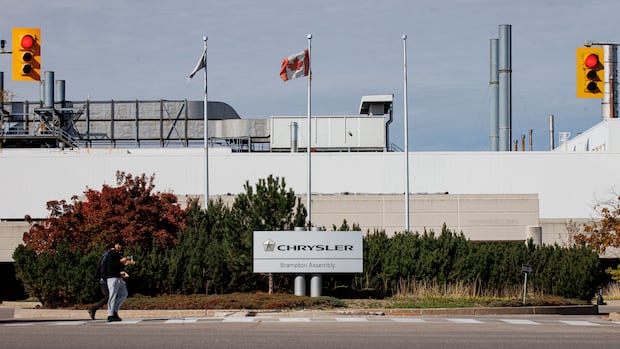
She emphasized on Tuesday that the production of the Jeep Compass “should have remained at the Brampton facility,” labeling it “a completely misguided decision.”
“To put it plainly, Stellantis needs to undertake significant efforts to mend its relationship with our members and the Canadian public,” she remarked.
“It begins with rectifying the situation for our members at Brampton Assembly, which means reinstating them to work on vehicle production, not shutting down or selling the plant.”
On Tuesday, Stellantis representatives described the labor discussions with the union as “an exceptionally crucial process” for the company’s future.
“The industry is experiencing a shift in the trade and regulatory framework, diverging from what was once a highly integrated market in Canada, and we must confront these challenges directly,” asserted Trevor Longley, chairman, president, and CEO of Stellantis Canada.
Longley highlighted that the company has invested over $8 billion across its Canadian operations since 2022. This investment has contributed to strengthening the company’s manufacturing capabilities and advancing battery manufacturing technology in Ontario.
“It’s fair to say that our long-term investment in Canada is significant, and this market will continue to be vital for us moving forward,” Longley informed reporters during the negotiations.
“This is a critical period for us. I believe [the negotiations] will be fair and responsible, and ultimately we will arrive at a mutually beneficial agreement.”
Tariffs heighten negotiation pressures
These talks occur amidst ongoing U.S. tariffs impacting local automotive manufacturers. A 25 percent tariff on all vehicles and trucks not manufactured in the U.S. remains enforced, except for those that meet the Canada-United States-Mexico Agreement (CUSMA) standards.
Recently, U.S. President Donald Trump threatened via social media to increase tariffs on all vehicles, auto parts, and steel imports from Canada to 50 percent starting January 1.
Describing the current economic climate as “an existential crisis for our auto sector,” Payne emphasized the importance of Canada firmly maintaining its automotive industry presence.
“The truth is — and Donald Trump recognizes this too — a 50 percent tariff on vehicles and components would effectively dismantle the entire North American automotive sector, likely within a week or ten days,” she stated.
“What we’re currently facing are similar threats that we have encountered for the past 18 months, and the only way to address these threats is to resist.”
Larry Savage, a labor studies professor at Brock University, remarked that Unifor is “engaged in a dual struggle” at present.
“During negotiations, the union is advocating for Stellantis to retain vehicle production in Canada and to accept the pattern agreement,” he noted in an email.
“Simultaneously, in Ottawa, Unifor is urging the federal government to reject any new trade agreements that could ultimately jeopardize the automotive sector in Canada.”
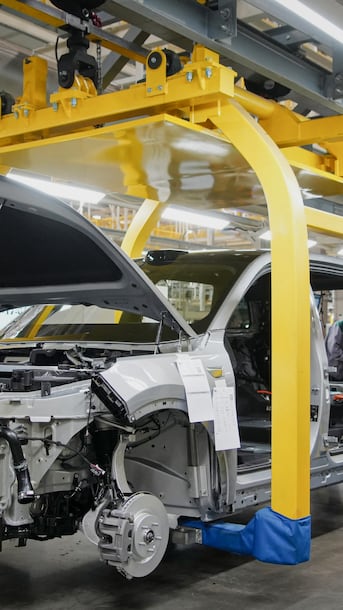
Car parts can cross international borders six, seven or even eight times before ending up in a vehicle. But amid a trade war, as both Canada and the United States raise tariffs up to 50 per cent, it’s getting more expensive — and complicated — to build cars. The CBC’s Acton Clarkin breaks it down.
He indicated that the ongoing contract negotiations extend beyond just Stellantis.
“The union is fighting to preserve the automotive industry in Canada. Securing the pattern agreement will be meaningless if the federal government compromises the auto sector amid a trade conflict with Trump,” Savage emphasized.
On Sunday, Unifor announced that its members at General Motors had overwhelmingly approved new contracts with the automaker, with 80.5 percent support from those in Oshawa, St. Catharines, and Woodstock, while Ingersoll members showed a 96.5 percent approval rate.
The three-year collective agreements raise wages for full-rate production members to $50.20 per hour and skilled trades workers to $62.71 an hour.
The union reported that its agreements with GM reflect the three percent annual wage increases achieved with Ford, which was the starting point for Unifor’s pattern bargaining with the industry.