

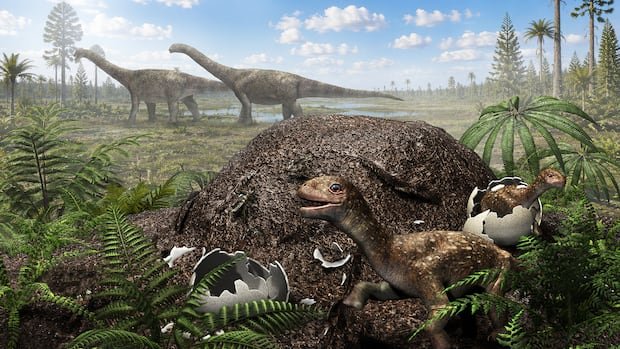

Fossil eggshells believed to belong to some of the largest dinosaurs ever discovered have been unearthed in a surprisingly cool climate distant from the equator. However, the enormous titanosaurs could not have kept their volleyball-sized eggs warm by brooding over them.
According to University of Calgary paleontologist Darla Zelenitsky, the titanosaurs employed a unique incubation method to keep their eggs warm enough for hatching without physically sitting on them. A recent study published by Zelenitsky and researchers from Japan and Argentina delved into the microscopic details of the eggshells to unravel the mystery.
By analyzing the tiny pores on the eggshells, the team concluded that titanosaurs likely utilized a similar incubation technique as modern crocodiles – burying their eggs in warm piles of decaying vegetation. The study, led by University of Tsukuba paleontologist Kohei Tanaka, highlighted this finding in the Royal Society Open Science publication.
Titanosaurs were colossal, herbivorous dinosaurs with long necks and tails, weighing up to 75 tonnes, comparable to half the mass of a blue whale. These gigantic creatures roamed on four legs and were a part of a lush coastal plain ecosystem where various dinosaur species coexisted with other animals.
The discovery of titanosaurs’ eggs in the Chorrillo Formation at the southern tip of Argentina, dating back to the Late Cretaceous period, shed light on their nesting habits in a climate similar to present-day New York City. The findings challenged previous assumptions about dinosaur nesting behaviors and showcased their adaptability to different environments.
The research highlighted the need for dinosaurs to maintain optimal egg temperatures for embryo development and hatching, which posed a challenge for larger species like titanosaurs. Unlike smaller, feathered dinosaurs that could brood over their eggs, titanosaurs had to rely on alternative methods to ensure successful incubation.
In contrast to sun-warmed sandy beaches favored by sea turtles, titanosaurs potentially buried their eggs in decomposing plant matter to benefit from the heat generated by microbial breakdown. The porous nature of the titanosaurs’ eggshells indicated a burial strategy, as observed in modern crocodiles and some bird species.
The study underscored the remarkable adaptability of dinosaurs, showcasing how even the largest species found innovative ways to reproduce and nest in different environments. The diverse nesting strategies of titanosaurs across various locations hinted at their successful global spread during the Late Cretaceous era, prompting further exploration into their nesting behaviors for a comprehensive understanding.