



As global bond yields reach levels not seen in decades, a once-overlooked sector of finance has become a focal point on Wall Street.
For many Canadians, this translates to increased borrowing expenses for certain financial products, including mortgages and auto loans, while offering enhanced returns on alternative investments like guaranteed investment certificates (GICs) and money market funds.
To begin, let’s clarify what a bond is. Purchasing a bond means you are essentially lending money to the issuer for a set period. This issuer could be a federal government, provincial authority, municipality, or a private entity. Investors typically receive interest payments until the bond matures, at which point they reclaim the bond’s face value.
So what exactly is a bond yield? It represents the annual income an investor generates from holding a bond, shown as a percentage. Once bonds are issued, they can be traded on the open market, leading to fluctuations in their prices. When bond prices decrease, yields increase, as investors receive the same interest payments for a lower purchase price.
The global bond market has been relatively quiet until recently. This calm was primarily due to central banks maintaining near-zero interest rates for over ten years after the financial crisis of 2008. However, an increasing number of investors are now anticipating interest rate hikes as central banks aim to combat persistent inflation.
When a central bank increases interest rates, new bonds come with higher returns, making existing lower-yield bonds less appealing.
Inflation Concerns Challenge Central Banks
Currently, the bond market is undergoing a significant global sell-off. Yields have surged to multi-year or even multi-decade highs in countries including the United States, Germany, Japan, and Canada.
“What’s driving this? Typically, substantial market movements occur due to multiple factors at play simultaneously,” stated Bank of Canada Governor Tiff Macklem on Wednesday, following the announcement of the central bank’s latest interest rate decision.
Rising inflation fears and worries about escalating government debt are shaping expectations for the Bank of Canada and its counterparts worldwide to increase their benchmark interest rates.
“Central banks have a limited capacity to tolerate higher inflation,” Macklem remarked. “This is prompting the market to factor in the likelihood of upcoming interest rate increases.”
Recent data from Statistics Canada indicated that gas prices significantly contributed to inflation spikes in July. On Wednesday, the Bank of Canada reported that global oil prices remain notably high, exacerbated by the ongoing U.S.-led conflict with Iran, which has affected crude shipping in the area. U.S. benchmark oil prices have surged by nearly 60 percent this year.
-
Inflation risks rise with higher fuel costs and new U.S. tariffs, Bank of Canada governor warns
-
‘Measured confidence’: RBC, TD Bank, CIBC share optimistic outlook for Canada’s economy
Simultaneously, the bank observes that the Canada-U.S. trade conflict is increasing costs for businesses, potentially leading to higher consumer prices over time. Macklem also highlighted that the expansion of AI infrastructure is driving the demand for new corporate bond issuances, thereby lowering the prices of previously issued bonds.
“All these factors are contributing to a rise in global bond yields,” noted Macklem.
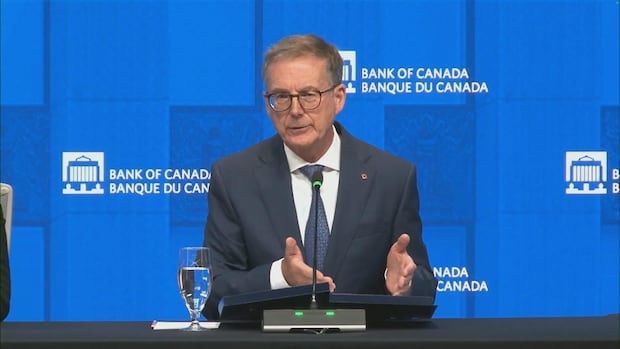
Bank of Canada governor Tiff Macklem states that the central bank will revise its forecasts, but currently assesses the ‘inflationary impact of those counter-tariffs is fairly modest,’ noting that the situation in the Middle East poses a greater inflation risk.
On Wednesday, Canada’s 10-year government bond yield reached a two-year peak, following indications from the Bank of Canada that inflation risks are mounting.
Since Canadian banks can invest securely with the government, the yields on government bonds influence all other lending rates. Fixed-rate mortgages, auto loans, and various credit types are tied to five-year and 10-year government bonds; thus, as yields for these bonds increase, banks tend to raise their interest rates for those loans.
For individuals seeking to invest their savings, the rise in bond yields compels banks to increase GIC rates to remain competitive, thereby enhancing guaranteed returns.
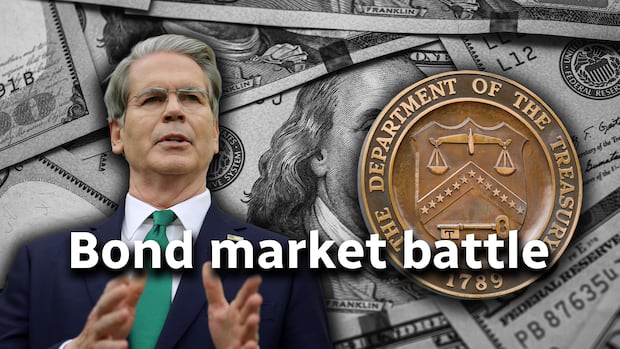
U.S. Treasury Secretary Scott Bessent’s recent actions in the bond market have raised concerns among numerous investors and analysts. Avneet Dhillon discusses worries that Bessent’s efforts to stabilize the markets and reduce borrowing costs may inadvertently exacerbate inflation.
‘A favorable moment to secure your mortgage’
Dan Eisner, founder and CEO of True North Mortgage, mentions that astute borrowers are securing their rates.
“Fixed mortgage rates are unlikely to see significant decreases until bond yields do. Sustained downward trends in yields are improbable unless there are clear signs of an economic slowdown and easing inflationary pressures,” Eisner stated in a blog post on Wednesday.
“If you’re planning to purchase a home or renew your mortgage, now is a good time to lock in your mortgage rate, as fixed-rate fluctuations are likely to be unpredictable for the foreseeable future, particularly until we gain more clarity on geopolitical situations and U.S. trade policies.”
Data from Google Trends indicates that Canadians are increasingly interested in the current turmoil within the bond market. The number of searches related to the bond market over the past month has surged by 5,000 percent year-over-year, according to the search engine.
No Signs of ‘Dysfunction’ in Canada’s Bond Market
Macklem indicated that while there has been some “spillover” effect from rising global yields into Canada’s bond market, the yield curve in Canada remains significantly below that of U.S. government bonds.
During a press conference in Ottawa on Wednesday, Carolyn Rogers, senior deputy governor of the Bank of Canada, reassured investors that, despite being influenced by global trends, Canada’s bond market is not in a precarious situation.
“It’s crucial to differentiate between volatility and dysfunction or instability when prices and yields fluctuate, as this reflects investors reassessing risk,” she explained to reporters.
“The risks we’ve discussed in our previous financial stability reports arise when leveraged investors rapidly adjust their positions, leading to liquidity shortages,” she added, referring to investors like hedge funds and non-bank asset managers who utilize borrowed funds to support their investment strategies.
“That’s the risk we are concerned about, but it is not something we are currently witnessing.”