

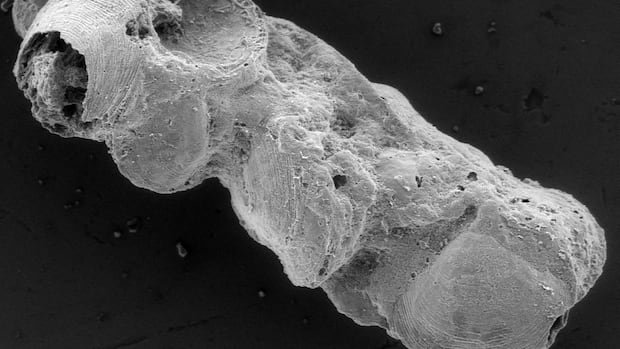

Long before the age of dinosaurs, a surge in biodiversity led to the emergence of early ancestors of modern animals and a rise in excrement. A recent study sheds light on the significance of coprolites, or fossilized feces, in understanding Earth’s ancient ecosystems, nutrient cycles, and present-day animal relationships.
Published in the journal Trends in Evolution & Ecology, the research delved into fecal fossils dating back to the Cambrian period, approximately 540 million years ago. Analyzing records of fecal matter from primitive worms, invertebrates, and mollusk-like creatures, scientists discovered that feces played a crucial role in enhancing deep-sea ecosystems and nutrient availability during that era, long before the era of dinosaurs.
The study’s revelation that feces were abundant during the Cambrian period holds key insights into the origins of modern ocean ecosystems. Julien Kimmig, co-author of the study and head of the paleontology division at the Karlsruhe Natural History Museum in Germany, emphasized the importance of understanding the vital role feces played in both ancient and contemporary ecosystems.
By examining coprolites from various deposits worldwide, researchers Kimmig and Russell Bicknell uncovered valuable information about the evolution of different species, feeding habits, and ecological dynamics during the Cambrian Radiation. The study highlighted how coprolites help unravel the complexities of Earth’s ecology and the transformative impact of the Cambrian Explosion on ecosystems.
Moreover, the research underscored how studying feces provides insights beyond animal behavior, offering clues about ecological changes, nutrient cycles, and their influence on biological diversity. This holistic approach, as emphasized by Kimmig, can aid in predicting and modeling future ecosystem changes based on past geological periods.
For paleontologists specializing in the Cambrian period, fecal analysis adds a new dimension to understanding this pivotal era in Earth’s history. The study revealed a notable increase in fecal matter during the Cambrian Radiation compared to the preceding Ediacaran period, indicating a significant shift in ecosystem dynamics.
Karen Chin, a paleontologist and curator at the University of Colorado Museum of Natural History, emphasized the underappreciated value of coprolites in paleontological research. She highlighted how coprolites offer unique insights into ancient interactions, such as predator-prey relationships and nutrient cycling, shedding light on past environments and biological adaptations.
Overall, the study advocates for greater recognition of the importance of coprolites in unraveling Earth’s evolutionary history and ecological transformations. By delving into the world of fossilized feces, researchers aim to unlock hidden secrets of ancient ecosystems and pave the way for a better understanding of modern and future ecological landscapes.