

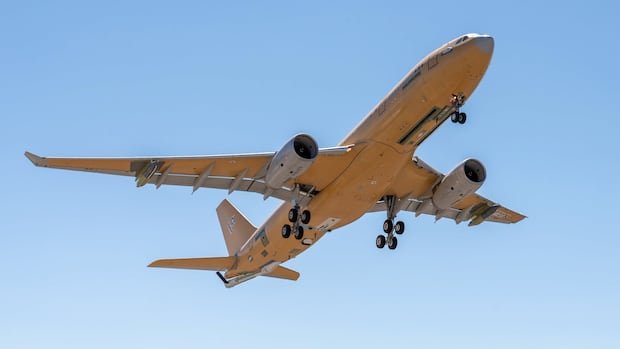

Canada’s air force is scheduled to receive the first of four new air tankers by the end of next year, a critical addition for refueling fighter jets in the Arctic. The Royal Canadian Air Force (RCAF) has provided details on the status of the CC-330 Husky fleet, which is intended to replace the aging Airbus 310s. These wide-body jets serve as the primary aircraft for the air force’s intercontinental operations, including transporting troops and the prime minister globally. However, their primary significance lies in their role as aerial refueling stations, particularly important as Canada enhances its continental defense efforts.
According to a Department of National Defence spokesperson, the initial new aircraft will be handed over to the RCAF in late 2027. In July 2023, Canada acquired nine Airbus A330s for about $3.6 billion, comprising five pre-owned jets with minimal service history from Kuwait Airways and four brand-new planes. The exact number of new aircraft expected to be delivered by next year was previously undisclosed.
Presently, three of the pre-owned Airbus planes have been received in their original configuration and are being utilized for passenger transport, including for the prime minister. One aircraft has entered scheduled maintenance, another is undergoing interior and defense upgrades in Switzerland, and the fifth is being converted into an air tanker in Spain. The first newly-built tanker is undergoing testing in Spain, while the other three are in production in Toulouse, France.
The RCAF’s fleet of CF-18s, soon to be joined by new F-35s, require air tankers for sustained Arctic patrols. These fighter jets consume fuel rapidly and rely on air tankers to extend their operational range and duration. This was demonstrated during the recent FIFA World Cup events in Toronto, where an aging air tanker enabled CF-18s to remain airborne over the stadium for extended periods.
The upcoming tankers are equipped with the necessary boom and hoses to refuel all NATO-compatible aircraft, addressing a limitation of the aircraft they are replacing. These new tankers feature a large boom essential for refueling U.S. Air Force-designed aircraft like the C-17 cargo plane and the F-35.
Regarding the new V-VIP Airbus jet being refitted in Switzerland for the prime minister, it will incorporate a “self-protection suite” to defend against potential missile threats. This suite may include laser systems, flares, and countermeasures like aluminum foil to confuse or deter incoming missiles. While most components of this system will not be visible, there will be distinct features on the aircraft’s exterior for identification and capability assessment by observers and foreign entities.
The air force projects the initial operational capability of the CC-330 Husky fleet by 2028-29, with full operational capability for all nine jets expected by 2032-33. The current aircraft are stationed in Ottawa, with new facilities under construction in Trenton, Ontario, and Edmonton.
The RCAF’s existing fleet of five Airbus A310s, known as the CC-150 Polaris, has been in service since the late 1980s, originally operated as Wardair passenger jets. One retired A310 now serves as a museum piece following its service to the last three prime ministers. Another A310 was written off in 2023 after a parking incident in Guam, with the remaining three aircraft set to remain in service until 2030.