

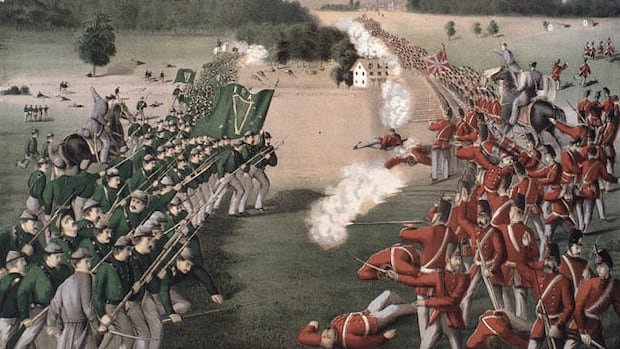

An overlooked clash on Canadian land just before Confederation might not resonate widely with Canadians beyond Fort Erie, Ont., but it holds historical significance. The Battle of Ridgeway, also known as Limestone Ridge, in 1866 marked the first time Canadian troops fought under Canadian leadership. This battle also inspired Decoration Day, a precursor to Remembrance Day still observed in some regions.
Despite its importance, the nine men who perished in the battle are not included in the Books of Remembrance on Parliament Hill, which honor fallen Canadian soldiers. A new petition, championed by Conservative MP Fred Davies, aims to have these nine men and the numerous others who died after the battle added to the list for recognition.
The Battle of Ridgeway was not a clear victory for Canada. Inexperienced volunteers confronted Fenian raiders, many of whom were veterans of the American Civil War. The Fenian Brotherhood, an Irish American group seeking Irish independence from British rule, attempted to invade and hold parts of British North America to negotiate for Ireland’s freedom.
In 1866, hundreds of Fenian raiders crossed the Niagara River with the intention of targeting the Welland Canal. They encountered approximately 800 Canadian volunteers from various regiments at Limestone Ridge near Ridgeway and Fort Erie. Historian Peter Vronsky highlighted the rapid mobilization of Canadians in response to the threat, despite their lack of proper supplies and preparation for what he termed as Canada’s first modern battle.
The Canadians engaged the invaders, but a Fenian bayonet charge led to a disorderly retreat. Nevertheless, the Fenians abandoned their incursion and retreated back to the U.S. side of the Niagara River. While the battle was a defeat, it halted the Fenian campaign, signifying a victory in repelling the invaders.
Davies emphasized that the battlefield loss does not diminish the sacrifice of those who died defending Canada. A memorial honoring the nine fallen soldiers was erected in 2016, yet efforts to have their names added to the Books of Remembrance have been unsuccessful.
The Battle of Ridgeway, though predating the official formation of Canada, had a lasting impact on the nation and its eventual Confederation. Vronsky suggested that the battle influenced those hesitant to support Confederation, playing a role in solidifying Canada as a unified entity.
The regiments that participated in the 1866 battle, such as the Queen’s Own Rifles and the Royal Hamilton Light Infantry, continue to exist today. Alexander Muir, composer of “The Maple Leaf Forever,” fought in the battle and drew inspiration for the patriotic song from his experiences. Vronsky proposed that the maple leaf in the Queen’s Own Rifles insignia might have also influenced Muir’s composition, symbolizing Canadians fighting for their community and identity.