

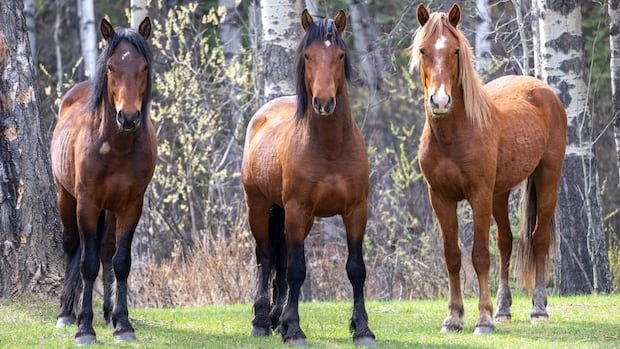

Health Canada has authorized the testing of a birth control vaccine on free-roaming horses in Alberta. The Alberta government deems horse populations in certain areas of the province as exceeding acceptable levels, necessitating control measures to prevent negative impacts on grazing areas for livestock and wildlife.
Contraception is among the strategies outlined in the province’s feral horse management framework, which also includes removal from the wild and adoption as population control methods. Health Canada confirmed that a “research authorization” was granted for the use of the SpayVac-Equid contraception vaccine in feral horses. However, this authorization is for research purposes only and not for general use.
The Alberta government is currently examining the approval specifics for horse contraception and is collaborating with stakeholders to implement management actions in a safe and scientifically sound manner. The latest feral horse survey in Alberta identified a record 2,072 wild horses in the six equine management zones, with populations in certain zones considered unsustainable.
In 2014, the province and the Wild Horses of Alberta Society initiated a contraception pilot project using the ZonaStat-H vaccine to assess its effectiveness for population control. The project revealed challenges such as high costs and difficulties in administering booster shots due to rugged terrain. Research suggested a significant percentage of female horses would need contraception for noticeable population reduction.
The new strategy involves capturing horses, administering the SpayVac-Equid vaccine manually, and marking vaccinated horses for identification. This method, with an 85 to 95 percent success rate, prevents conception for three to four years without altering herd dynamics and eliminates the need for booster shots. The Wild Horses of Alberta Society aims to launch the contraception project this fall as part of a broader population control approach, including capturing young stallions for removal from the wild.
The society, established in 2002, focuses on rescuing, rehabilitating, and adopting horses, with over 200 horses taken in since its inception. The provincial government’s objective is to manage horse populations effectively to accommodate various land users’ needs and interests.