

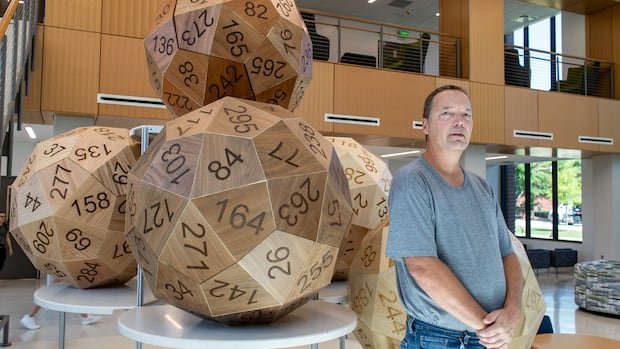

In 2012, mathematician Eric Harshbarger was challenged by a board game designer during a gaming convention to create dice that could determine the starting player without the possibility of a tie. The aim was to expedite the game setup process and allow players to begin playing promptly.
Harshbarger, a senior lecturer at Auburn University in Alabama, found the challenge intriguing as it lacked a straightforward solution, which appealed to his mathematical expertise. He envisioned a set of dice where each player could roll one die, ensuring a fair outcome with no ties.
Despite the theoretical concept, developing practical dice proved to be a complex task. After nearly 15 years of collaboration with colleagues, Harshbarger successfully invented the Go First Dice for five players, allowing for a guaranteed winner from a single roll.
Initially focusing on four 12-sided dice for fewer players, the team quickly solved the puzzle for smaller groups. However, designing dice for five players posed a greater challenge. While a solution with 1,440 sides was mathematically possible, it was impractical for manufacturing.
Through continuous experimentation and collaboration, the team eventually settled on a set of five 120-sided dice, thanks to a breakthrough by a researcher from Australia. Subsequently, a Canadian software engineer, Paul Meyer, contributed by devising a solution using five 60-sided dice.
Meyer’s computational approach, based on mathematical patterns and extensive computer searches, led to a successful outcome. Despite concerns about the dice’s practical application, Harshbarger affirms their fairness is rooted in solid mathematics, with any manufacturing imperfections being the only potential source of bias.
The research group, now including Meyer, continues to explore further possibilities, such as reducing the sides for a five-player set and potentially expanding the concept to accommodate six players. Harshbarger emphasizes the ongoing nature of their work, welcoming unexpected contributions that could offer new perspectives and solutions to the dice problem.