

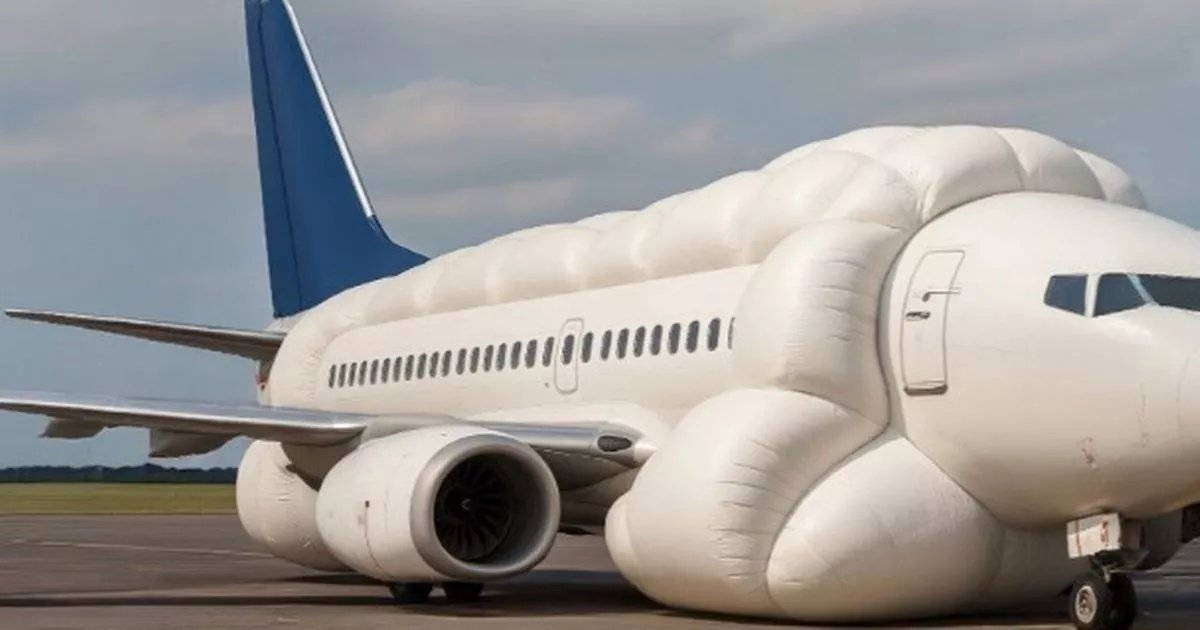

In the aftermath of the tragic Air India crash that claimed 260 lives in June, engineers are actively exploring innovative solutions to prevent such large-scale disasters in the future. One unconventional but potentially life-saving idea gaining attention is Project Rebirth, envisioned to revolutionize aircraft safety by introducing a system of massive airbags, akin to those in cars, to render planes crash-proof in unavoidable emergency situations. Initiated by two enterprising engineers from the Birla Institute of Technology and Science (BITS) Pilani Dubai campus, the project integrates smart airbags, impact-absorbing fluids, and mid-air reverse thrust mechanisms to transform fatal crashes into survivable landings.
The brains behind this groundbreaking concept, Dharsan Srinivasan and Eshel Wasim, conceived Project Rebirth while participating in the prestigious James Dyson Award competition. Positioned as a finalist for the esteemed accolade recognizing transformative inventions, the project focuses on three core principles: mitigating impact, reducing descent velocity, and absorbing energy, thereby introducing what they term as the ‘first AI-powered crash survival system.’ Rooted in personal tragedy, the duo’s motivation stems from a deep-seated desire to address the helplessness experienced during aviation disasters.
Project Rebirth’s operational framework involves a sophisticated array of technologies aimed at predicting, decelerating, protecting passengers, and facilitating rescue efforts in the event of a crash. Through an AI-driven monitoring system, the aircraft’s vital parameters are continuously assessed, enabling rapid deployment of high-speed airbags from multiple sections of the plane within seconds if a crash becomes imminent below 3,000 feet. These airbags, composed of specialized fabric, form a protective cocoon around the aircraft, ensuring a controlled descent regardless of the plane’s velocity.
Apart from airbags, the proposed system incorporates a reverse thrust feature to slow the descent using engine power or gas thrusters, along with smart fluids that transition from soft to rigid upon impact to minimize injuries. Additionally, rescue aids such as bright orange shells, GPS trackers, infrared beacons, and exit lights are integrated to assist in locating crash sites and aiding survivors. The creators envision integrating Rebirth into existing aircraft models or incorporating it into new designs, potentially collaborating with aerospace laboratories to validate their concept.
While the technical feasibility of Project Rebirth is yet to be validated, the duo’s aspiration to enhance crash survivability in aviation marks a significant departure from traditional safety measures that primarily focus on accident prevention. As the global winner of the James Dyson Award is set to be unveiled in November, the fate of this groundbreaking innovation hangs in the balance, awaiting further scrutiny and evaluation.